Thursday, August 31, 2006

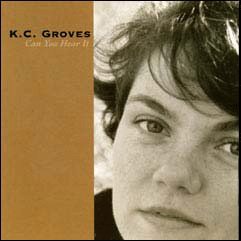
K. C. Groves - Can You Hear It

K. C. Groves is the one of the members of Uncle Earl, an all female bluegrass/old music band. Abigail Washburn, whose album I previously reviewed, is also a member of this group. I bought this CD at their concert, because out of all the very talented members, I was most impressed with Miss Groves. (As a side note, I now have a huge crush on her, so if you're reading this K.C., the contact info for the tall handsome guy at the back table is in my profile.)

Just kidding.

Anyway, live, Miss Groves sounds like Patsy Cline reincarnate. On her album she's a bit closer to Alison Krauss without the "I'm three years old" quality to her voice, but still really good. And she's a talented musician. On this album, she plays guitar and mandolin, and sings all the songs, which she wrote. Guest musicians include Tim O'Brien and Peter Rowan, so she's got some pretty good friends helping her out too.

The title track is a paean to old time music, with the repeating refrain "can you hear it, or is it just me?" She follows this with a few pensive ballads. Though by no means the most innovative lyricist, I was impressed with some of her poetry in these songs too. "You Think We're Friends" is rather clever at times, with the hook of the song being "you think we're friends/but I'm in love with you."

After several listens, the only song I'm not a huge fan of is "Pony Days" which is just a bit too cutsey. "I traded my ponies for new clothes and boys/and now that I'm older, I question that choice" is her theme here. What? No, thanks. Fortunately, the album picks up again from here and finishes strongly. The final track is a wistful reflection, with the best poetry on the album: "And the world turns around/The sun comes up and the sun goes down/questions abound/still the world turns around."

Like most albums, it is easy to find some fault with it. Unlike many, it rises above those faults to be a solid piece of work. Recommended.

The concert, as a whole, was amazing. Solid instrumentals, tight harmonies, Kristin Andreasson doing some clogging, and exceptional fiddle playing by Rayna Gellert. Abigail Washburn, whom I compared favorably to Emmylou Harris, has a bit of Mahalia Jackson in her as well. Most times, when a band is encored, they'll play a real rousing send-off to get everyone out on a high. But this one was different. Miss Washburn led an a capella call-and-response gospel tune titled "Keys to the Kingdom" and got the entire crowd singing the chorus. It was simply beautiful.

So if you're in an area where Uncle Earl is touring, go out and see them. You won't regret it.

Wednesday, August 30, 2006

Learning to ask questions

I signed up to be a student interviewer for the incoming class of 2011, and today was the training class for interviewers. I was most impressed by one point the instructor made. She encouraged us to ask difficult, controversial questions of the applicants, just to see that they can think on their feet, etc. But she added, "the one question you aren't allowed to ask is anything relating to abortion." I was rather mystified. But rules are rules. The other great line, she said "please reserve a ranking of 1 (the highest we can award an interviewee) for someone who walks on water, leaves you breathless, and is generally everything you could possibly desire from an applicant."

I'm excited about interviewing though. I love my school, and I look forward to having some say in what its future looks like. I'm also looking forward to asking odd questions. When I prepped for med school interviews, we were told to be prepared for such off the wall questions as "who won the 1968 World Series" or "Who do you think killed JFK?" But no one ever asked me any odd questions. The hardest one I got was "what historical figure would you most like to meet and why?" I think that interviewer will probably always remember me, because my answer, with only a second's pause, was "Genghis Khan." That was an interesting conversation.

I wasn't accepted at that school.

More to the point, I'm looking forward to the opportunity to hone my interviewing skills from the other side of the table. I've done quite a few interviews in my scholastic and professional career, and seeing all angles will probably make me better at them.

I'm reminded, in writing this, of something I read today in Dorothy Sayers' Mind of the Maker. She states "[i]t is a plain fact that ninety-nine interviews out of a hundred contain more or less subtle distortions of the answers given to questions, the questions being, moreover, in many cases, wrongly conceived for the purpose of eliciting the truth."

Here's hoping I can elicit truth effectively and fairly, without distortion.

Good thing everyone gets two interviews, eh?

Monday, August 28, 2006

USMLE, Step 2

It is done. An interesting test, on the whole. Eight blocks of 46 questions each, and you get one hour allotted time per block. You have one hour of break time, to divide between slots as you see fit. And then if you finish a block early, you get that extra time added to your break. Med students, usually my classmates more than I, spend a ridiculous amount of effort figuring out exactly how long they will take for a break between each block. One of the study guides I used even has a plan written out in it. My personal strategy, should anyone care, was to do two blocks straight through, refuel with coffee, do another two blocks, more coffee, and then, since I had about an hour and twenty minutes of break time saved up, I took about 5-10 minutes between each of the following blocks to get more coffee and sugar. Before the last one I took about half an hour, just so I wouldn't be dragging. But it worked out, and I am done. Only one more test that matters between me and graduation.

Oh, and should anyone be reading this for advice, having found it through Google: Kaplan questions are exactly like the real thing, and Oasis's song "Don't Look Back In Anger" is great to have running through your head as a soundtrack. But that's just me.

EDIT: In response to a concern voiced to me privately, yes, I did eat dinner. A large dinner. To make up for having only coffee and sugar for 8.5 hours straight.

Friday, August 25, 2006

Ready for return

My time in the cadaver lab is winding down, and I am definitely ready for a return to the hospital. I like the academic side of medicine all right, and doing a second cadaver dissection has been a great learning experience, but people are more interesting when they are alive. Plus my blog posts are way less boring when they are funny stories, rather than quasi-philosophical musings. So, just about a week and a half to go, and then hopefully a return to more amusing, or charming, or poignant anecdotes, which is the reason I started blogging anyway. I figure if I don't particularly like my blog, there's no way anyone else will, right?

Wednesday, August 23, 2006

Biblical justification for abortion?

The always interesting Slate magazine has recently had a series of articles called "Blogging the Bible" in which David Plotz, by his own admission a not-very-observant Jew, reads through the Torah and writes his musings as he goes. He states frankly that he has never done this before, and his stated purpose also includes avoiding the use of commentaries to aid understanding. It's been fascinating to read the occasional post, and today I was revisiting some older posts in the series. I must have missed this one the first time. He says:
Reader Dan Gorin points out that my last entry missed the fascinating law that comes right before "eye for an eye" in Chapter 22. If a man pushes a pregnant woman and she miscarries, but is not otherwise hurt, then the offender pays only a fine to the victim's husband. This has interesting implications for how we think about abortion—in particular about the claim that killing a 17-week-old fetus is the same as killing a 17-year-old. According to Exodus, it's not. As Gorin writes: "The text seems to clearly state that the destruction of a fetus is not a capital offense. It is a property crime for which monetary compensation is paid."

This was an eye-opener for me. I have actually read through Exodus, but I didn't see this in this light when I went over it. As Mr.Plotzz mentions, if fundamentalist Christians are going to take the injunctions about homosexuality so literally, why not this verse too? Not being bound to the "no commentary" code of Mr. Plotz though, I looked at several versions, and found a confusing array of translations for that word "miscarry". First, the verse, in the American Standard translation, says:
Exodus 21:22
And if men strive together, and hurt a woman with child, so that her fruit depart, and yet no harm follow; he shall be surely fined, according as the woman's husband shall lay upon him; and he shall pay as the judges determine.

It seems the Hebrew literally says "her children come out of her, but there be no harm done." It seems to me that this means a premature birth occasioned by the trauma previously described, which results in no harm to either mother or child. This is the opinion of the commentaries I can find, but it seems some very smart people have thought the harm mentioned applies to only the mother. The earliest reference to this I can find is in the Vulgate, so maybe Jerome is at fault. He's caused confusion enough other places, I guess.

I wonder though, given the apparently contentious nature of the passage, that a bigger deal isn't made out of it, especially with the pro-abortion side of the debate trying harder to be more religious lately.

Next intruiging point here, is that the very next verse says:

"But if any harm follows, then you shall give life for life, eye for eye, tooth for tooth, hand for hand, foot for foot, burn for burn, wound for wound, stripe for stripe."

So this is important enough that God decides here to give the famous "eye for an eye" pronouncement. If the harm referred to is intended to be harm to the child or to the woman, then obviously it is taken very seriously. I'm getting the feeling that the preponderance of translators, and certainly those not influenced by Jerome, have concluded that the "harm" means harm to the woman or the child, and that the context implies merely a premature birth. This probably makes sense, when considered as a whole, but looking back a few verses to Ex 21:20 we read that if a servant is struck by his master with a rod and died, the master will be punished. Not executed, punished. So apparently, in the Hebraic law, there is a gradation of worth in lives.

What is to made of these considered together? Should we conclude that abortion is not murder? Is it merely a finable offense? Am I making a mistake in expostion here?

This is not an easy thing for me to write, because I don't have an answer that completely satisfies me and I wonder about the conclusion. Joel, if you read this, I'd be especially interested to hear your rather more educated opinion on the subject.

Tuesday, August 22, 2006

Cultural Relevance

It is probably not difficult to tell from my musings here that I think engagement with culture is important. I truly believe my quote to the right about what gives medicine a point. I've been considering these convictions today, in light of some posts on Slice of Laodicea, a Christian website I read occasionally. This site has recently been denigrating the emergent church, and using some stereotypes to paint pretty broad strokes. I discovered today that I'm not the only one who noticed this, and there is a bit of a terse exchange of posts going on between the players in this debate.

The debate, as such, has little or no bearing on me here. I certainly don't want to get into it right now. I think (a) a lot of the debate there is going to end up being fruitless, (b) I don't have much exposure to the emergent church, and (c) I'm more interested (now anyway) in one of the underlying points.

My concern is more with cultural engagement in the abstract. I said in an email to one of the people running Slice that "I am very wary of Christians who have a knee-jerk "anything about this culture is evil" reaction. It is simply uneducated and worse, illogical...I think the fundamental concern I have is Christians who take to heart only the verses pertaining to how the gospel will seem foolishness to the world, and then use that as an excuse to be foolish." This seems, sadly, to be the case for many of the readers of that site. They excoriate musicians who try to make Christian rap, not on the merits of their artistry, but on the basis that rap music is itself evil. And the readers of that site are by no means singular. Now rap may be a bad form of art, or even a construct solely for the purpose of making money off white suburban kids, and Nameless, the Christian rapper castigated in Slice, may not be great rapper, but it is more important to address him on the terms of his art. Call him derivative, critique his poor production, but don't dismiss him before listening. I don't think there are many (if any) forms of art that can be called evil in the abstract, and the role of the Christian in art, in science, in medicine, accounting, or any other sphere of human endeavors ought to be to redeem it for Christ.

To the credit of Slice, the reply I got from Jim Bublitz was on target, and he said (replying to my suggestion of reading J. Gresham Machen on the subject) "Be careful not to go off the deep end with cultural relevance. I'm familiar with Machen, and I know that he had a good balance on this...I agree with your statement that the foolishness of the Gospel should not be used as an excuse to be foolish. Your reasoning (and logic) can be taken to an unbiblical extreme however, to the point where cultural demands out-weigh scriptural demands."

Certainly an understandable and reasonable response. But without understanding (a rare gift, to be sure) this attitude is taken by many to be carte blanche to treat the world as latter-day Gnostics or Manicheans and see anything that doesn't take place inside the walls of church to be evil. It isn't. We are all part of the world, and though it must always be viewed through the lens of Christianity, we cannot help viewing it. Machen puts it thus:

[W]hat more pressing duty than for those who have received the mighty experience of regeneration, who, therefore, do not, like the world, neglect that whole series of vitally relevant facts which is embraced in Christian experience—what more pressing duty than for these men to make themselves masters of the thought of the world in order to make it an instrument of truth instead of error?
...
Are then Christianity and culture in a conflict that is to be settled only by the destruction of one or the other of the contending forces? A third solution, fortunately, is possible—namely consecration. Instead of destroying the arts and sciences or being indifferent to them, let us cultivate them with all the enthusiasm of the veriest humanist, but at the same time consecrate them to the service of our God.


This, I think is the attitude Christians ought to be taking. It is not an easy path, but nothing worthwhile is easy. And though I don't know that rap music is a worthwhile enterprise, I do know that monasticism is not the solution, and neither is angry denunciation of anything that doesn't come straight of the Bible.

Abigail Washburn - Songs of the Traveling Daughter

One of my residents asked me once how I find the odd bands I listen to. I couldn't really give her a straight answer, but I do know how I found this one. I was taking a study break, wandering the aisles of my local Barnes and Noble (not exactly the best place to pick up obscure music, I'll grant) and this cover caught my eye.

One of the great things about Barnes and Noble is being able to listen to CDs before you buy them, and it didn't take more than a short listen to be intrigued.

Abigail plays banjo in the old frailing style. She also sings, and has a pleasantly distinctive voice. And though in saying it I worry that I am repeating myself she does sound a bit like Emmylou Harris at times. However, this is almost never a bad thing, and Abigail's style is different enough that she does not sound derivative. Indeed, it would be difficult to sound derivative here, for what sets her apart from being just another old-time singer (aside from her great talent) is the fact that two of her songs are sung in Chinese. Oddly enough, it works.

She's also managed to attract some serious talent to back her up here. Bela Fleck plays banjo on several songs, and though he isn't credited on this album, Tim O'Brien played on her first EP. That's some serious bluegrass firepower. When (as far as I can tell) it is just Abigail playing, her banjo is competent, and though not displaying the complicated virtuosity of Doc Watson or Adam Hurt, it is solid.

Overall, the album is a great listen, with tearjerker ballads, gospel, and blues mixed together. "Rockabye Dixie" is an incredible lullaby. The Chinese pieces come late on the album. One is a bluegrass song translated into Chinese, and another is an original inspired by an old Chinese poem. Since speaking Chinese is not one of my skills, I can't judge the merits of Miss Washburn's linguistic abilities, but the songs sound great. Song of the Traveling Daughter, the title track, starts out like a ballad, but becomes a barnburner by the end. The Lost Lamb, the other Chinese track, would not be out of place on the Crouching Tiger, Hidden Dragon soundtrack. It's just her voice with a solo cello, and as I listened to it, I was reminded of the Xinxiang desert scenes in that movie.

The only minor quibble is that on at least one song, "A Single Drop of Honey", Miss Washburn has written the melody outside her range, and the strain to reach certain notes is distracting. Relatively minor, but it keeps the album from being perfect.

Still, she will be in concert near here soon, and I plan on taking in the show.

4/5 stars