A number of months ago I discharged a patient to a physical rehabilitation center. This is pretty common, and it seems especially so in internal medicine, where there is a large proportion of old patients with multiple problems complicated by poor physical condition.
Mr. Sigursson was not happy about going to this place though. I had tried to walk him around the ward, and he got short of breath just getting out of bed. He was too deconditioned to brush his teeth. But his wife had died six months before in a similar institution, and as he expressed at length to me: "I'm 93 years old, I've been an elder in my church, I've founded charitable organizations, I've done all the fishing I'll ever do, and now I've sold my house, my boat, and everything else that I used to do to live in an assisted living apartment. I'm done with life, why the hell do I need rehab?"
In short, he was ready to join his wife.
Honestly, I didn't know that rehab would do him any good. He was pretty sad, and he had great reasons for being so. He wasn't motivated to succeed with physical therapy, and as he said, he had little to look forward to once he got out. I always feel a little out of place, being 27 and telling people nearly four times my age that "there's a lot left to live for."
So it was with great pleasure, and not a little amusement, that I saw him at the grocery store today, pulling his walker out of the bed of his pickup truck without lowering the tailgate.
He was smiling.
Saturday, January 19, 2008


Monday, January 14, 2008
Cross cover
Being on call overnight gives an intern a great idea how strong his fellow interns are. The weaker of my fellows will have signed out patients who lack pain PRN meds, have restraint orders that need to be signed, or a host of other administrative issues guaranteed to keep me awake.
It also demonstrates some of the odder quirks of humanity. I was paged by one of my favorite nurses a few nights ago "because one of the patients up here has a present for you." I tried cajoling the nature of the "present" out of her, but she insisted I come and see it for myself. She's one of the nurses I know fairly well, and more importantly I know she doesn't page me unless it is necessary, so I headed up four flights of stairs to see what was going on.
When I got there, the nurse dropped a small white object into my hand and told me the story. Mrs. Culloden, a pleasantly demented, frail lady in her 80s who is constantly threatening to leave AMA to go smoke, had become convinced that the vancomycin in her PICC line was "invading her body." Her logical response, rather than asking a nurse for help, was to take the plastic knife from her dinner tray and cut the port off her PICC line. So the vancomycin was on the bed, and the wanderingly apologetic Mrs. Culloden was one step further back on her cellulitis treatment. Clamp, wrap, and place on 1 to 1 monitoring. All in a day's work.
It also demonstrates some of the odder quirks of humanity. I was paged by one of my favorite nurses a few nights ago "because one of the patients up here has a present for you." I tried cajoling the nature of the "present" out of her, but she insisted I come and see it for myself. She's one of the nurses I know fairly well, and more importantly I know she doesn't page me unless it is necessary, so I headed up four flights of stairs to see what was going on.
When I got there, the nurse dropped a small white object into my hand and told me the story. Mrs. Culloden, a pleasantly demented, frail lady in her 80s who is constantly threatening to leave AMA to go smoke, had become convinced that the vancomycin in her PICC line was "invading her body." Her logical response, rather than asking a nurse for help, was to take the plastic knife from her dinner tray and cut the port off her PICC line. So the vancomycin was on the bed, and the wanderingly apologetic Mrs. Culloden was one step further back on her cellulitis treatment. Clamp, wrap, and place on 1 to 1 monitoring. All in a day's work.
Monday, January 07, 2008
Seriously
I'd just like to say that I'm, well, I'm searching for the right word to describe my feelings towards a certain pain management doc. The one who told my patient, perhaps the most difficult patient I've ever had to deal with, the one with a fragile ego and chronic pain and a sense of entitlement and probably borderline personality disorder, the one I spent two weeks getting stabilized on a pain management regimen while an inpatient, told this patient that "methadone is a drug for heroin addicts." So now the patient is back, refusing the one drug that got him out of the hospital, and I guess I really want to transfer all of his pain to the idiot pain management physician.
Sigh.
Sigh.
Thursday, January 03, 2008
Just another patient
I occasionally read other medical blogs, and the posts I usually enjoy are the ones with a gripping story. I've told a few myself. But there haven't been many in my own field. Unless I'm dropping lines or coding people in the ICU, my job is a lot of talking to people and writing long notes. It isn't all that surprising to me that I'm interested in the more procedurally oriented subspecialties.
All of which made it easy to overlook Mr. Arthur. He suffers from Parkinson's disease and dementia, so when I read that on the chart in the ER and then heard him say "I've never had a tremor before" I discounted his story, chalking him up as another demented patient with poor historical skills. I had gotten called on two patients at once, so I left Mr. Arthur to tremble in his bed a little longer while I got the much more exciting acute pancreatitis patient upstairs.
Coming back to Mr. A, I got his story a little clearer. He was worried. Worried that his home blood pressure cuff was giving widely variable readings, worried that the ER doc told him his heart was in trouble because of "a tremor in the way it beats" (the ER resident meant atrial fibrillation) and worried because his baseline tremor was getting bit worse. I was able to fix one concern right away, (and this illustrates my irritation with the ER residents) by just looking at his EKG. There was certainly an EKG showing atrial fibrillation in Mr. Arthur's chart, but the problem was it said "Betsy Rosengard" across the top. Mr. Arthur's EKG was not completely normal, but it certainly hadn't changed from the last time he had been admitted, a year previously. The tremor I wasn't sure about, but his blood pressure concerns, especially in a 90 year old man, were enough to warrant at least a 23 hour observation period. I got him upstairs and promptly was swamped by the other 30 or so patients requiring my attention.
Later that night, I was going through Mr. Arthur's clinic notes in a bit of downtime, and I noticed that his primary neurologist mentioned he was a writer. I checked his name on Amazon and found that my patient had written 11 books, several on the Korean war, in which he fought, and a few on other American conflicts. So when I swung by his room on my evening rounds, I asked him about it. He brightened up immediately, and began telling me his life story. Though his mind wanders at times, he is still quite sharp, and he told me about joining the Canadian Army in 1940 because he was desperate to "kill them Nazi bastards." While there he met King George VI. He transferred to the American Army after Pearl Harbor and was made a tailgunner in B-26s. He didn't want to fly and so transferred to the infantry, where he went to Germany after the surrender to guard POW camps. He still remembers the names of the SS officers he was charged with keeping under lock and key. After WWII he came home and married, staying in the Army and going to Korea, where a lot of the experiences in his books come from, apparently.
I was amazed I had ever seen this fascinating man as just another patient. I realized that I just hadn't given him a chance to tell his story, and that all of his concerns were valid, he just didn't talk fast enough to convince me in the 30 seconds I had given him.
I didn't want to leave, but I had to let the man rest, and I had other patients to see, but I came back to his room the next day and chatted for over an hour after I had signed out, and could have been at home, asleep.
I may regret not sleeping that extra hour this afternoon, someday, but I doubt it.
All of which made it easy to overlook Mr. Arthur. He suffers from Parkinson's disease and dementia, so when I read that on the chart in the ER and then heard him say "I've never had a tremor before" I discounted his story, chalking him up as another demented patient with poor historical skills. I had gotten called on two patients at once, so I left Mr. Arthur to tremble in his bed a little longer while I got the much more exciting acute pancreatitis patient upstairs.
Coming back to Mr. A, I got his story a little clearer. He was worried. Worried that his home blood pressure cuff was giving widely variable readings, worried that the ER doc told him his heart was in trouble because of "a tremor in the way it beats" (the ER resident meant atrial fibrillation) and worried because his baseline tremor was getting bit worse. I was able to fix one concern right away, (and this illustrates my irritation with the ER residents) by just looking at his EKG. There was certainly an EKG showing atrial fibrillation in Mr. Arthur's chart, but the problem was it said "Betsy Rosengard" across the top. Mr. Arthur's EKG was not completely normal, but it certainly hadn't changed from the last time he had been admitted, a year previously. The tremor I wasn't sure about, but his blood pressure concerns, especially in a 90 year old man, were enough to warrant at least a 23 hour observation period. I got him upstairs and promptly was swamped by the other 30 or so patients requiring my attention.
Later that night, I was going through Mr. Arthur's clinic notes in a bit of downtime, and I noticed that his primary neurologist mentioned he was a writer. I checked his name on Amazon and found that my patient had written 11 books, several on the Korean war, in which he fought, and a few on other American conflicts. So when I swung by his room on my evening rounds, I asked him about it. He brightened up immediately, and began telling me his life story. Though his mind wanders at times, he is still quite sharp, and he told me about joining the Canadian Army in 1940 because he was desperate to "kill them Nazi bastards." While there he met King George VI. He transferred to the American Army after Pearl Harbor and was made a tailgunner in B-26s. He didn't want to fly and so transferred to the infantry, where he went to Germany after the surrender to guard POW camps. He still remembers the names of the SS officers he was charged with keeping under lock and key. After WWII he came home and married, staying in the Army and going to Korea, where a lot of the experiences in his books come from, apparently.
I was amazed I had ever seen this fascinating man as just another patient. I realized that I just hadn't given him a chance to tell his story, and that all of his concerns were valid, he just didn't talk fast enough to convince me in the 30 seconds I had given him.
I didn't want to leave, but I had to let the man rest, and I had other patients to see, but I came back to his room the next day and chatted for over an hour after I had signed out, and could have been at home, asleep.
I may regret not sleeping that extra hour this afternoon, someday, but I doubt it.
Monday, December 31, 2007
Serendipity
My hospital is an odd combination of old and new technology, because physicians hand-write orders, but then the nurses enter them in a computer. It's a bit ridiculous, but for some reason some paper pusher somewhere figured it will save money.
Anyway.
Recently I admitted a patient with vague abdominal pain, and since the surgeons decided not to cut him open and the ER attending wouldn't let me send him home, the guy was admitted. (That's another whole story) We gave him a laxative and some Motrin, but figured we'd also try to figure out if anything else was going on, so among other things I wrote for an anti-S. cerevisiae level, as this antibody is elevated in Crohn's. The nurse taking off the orders was new, and unfamiliar with the computer, which will auto-complete the orders as they are written, and instead she sent an Ascaris lumbricoides battery. I've had similar problems with the computer before, and as both of the computer abbreviations for these labs begin "ASC..." it was an easy mistake to make.
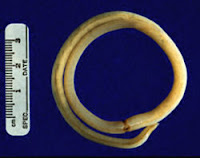 Ascaris, for the one or two non-medical readers out there, is a roundworm which is very common in third world countries, but not so much in the yuppie demographic my patient belonged to. I saw the order in the computer later on the night of admission, and went to change it, but the original had already been sent. So we sent the Crohn's lab and thought no more about it.
Flash forward a week. The patient is discharged, and as far as I know still having the vague abdominal pain when his labs start to come back. And though he doesn't have Crohn's, he does have roundworms. It's an easy disease to treat here in America, but we never would have caught it if the nurse had had more training.
Anyway.
Recently I admitted a patient with vague abdominal pain, and since the surgeons decided not to cut him open and the ER attending wouldn't let me send him home, the guy was admitted. (That's another whole story) We gave him a laxative and some Motrin, but figured we'd also try to figure out if anything else was going on, so among other things I wrote for an anti-S. cerevisiae level, as this antibody is elevated in Crohn's. The nurse taking off the orders was new, and unfamiliar with the computer, which will auto-complete the orders as they are written, and instead she sent an Ascaris lumbricoides battery. I've had similar problems with the computer before, and as both of the computer abbreviations for these labs begin "ASC..." it was an easy mistake to make.
 Ascaris, for the one or two non-medical readers out there, is a roundworm which is very common in third world countries, but not so much in the yuppie demographic my patient belonged to. I saw the order in the computer later on the night of admission, and went to change it, but the original had already been sent. So we sent the Crohn's lab and thought no more about it.
Flash forward a week. The patient is discharged, and as far as I know still having the vague abdominal pain when his labs start to come back. And though he doesn't have Crohn's, he does have roundworms. It's an easy disease to treat here in America, but we never would have caught it if the nurse had had more training.
Friday, December 21, 2007
To line or not to line?
This month I'm back on the inpatient wards, and for a variety of reasons (not least of which, I flatter myself, is my outward impression of competency) my senior resident has been very hands off in dealing with me. She lets me know if there's a patient in the ER to see, and then swings by about 45 minutes later to see what my plan is. The confidence is good for me, because I'm realizing I actually have learned a lot in the past few years. Pulmonary embolism? I know what to do. Diabetic ketoacidosis? I'm all over that. But only recently have I started standing up for my ideas against those of my seniors.
From my perspective as an intern, desperate for procedures and learning opportunities, it might have been a bad idea. Mrs. Wilkins was a 70-something year old diabetic with renal failure, and the ER was unable to get IV access on her. Normally they would just stick a central line and call us, but we weren't particularly busy and admitted the patient before they had the chance to. Once we got her up to the floor, my senior told me to get consent and then put in a central line. I was fairly excited about the prospect, because I'm getting close to having done enough not to need supervision for this procedure. But I'm trying to be an internist, so I sat back and considered for a minute. Mrs Wilkins didn't need a central line, she needed maybe a little fluid and the occasional lab. Since we hadn't gotten an IV downstairs we didn't have coagulation labs, and for all I knew she had an INR of 4. So instead I grabbed one of the techs from peds and he got a nice peripheral line on the first try. We gave Mrs. Wilkins her fluids, readjusted her insulin regimen, and sent her home two days later.
It's not a particularly moving story, I know. But it stands out to me as one of the first times I went for something less exciting because I was thinking for myself, and for the patient, rather than for a check box in my training. It was a small step on my road from technician to physician. And even if I still need another central line or two, that step was the more important one.
From my perspective as an intern, desperate for procedures and learning opportunities, it might have been a bad idea. Mrs. Wilkins was a 70-something year old diabetic with renal failure, and the ER was unable to get IV access on her. Normally they would just stick a central line and call us, but we weren't particularly busy and admitted the patient before they had the chance to. Once we got her up to the floor, my senior told me to get consent and then put in a central line. I was fairly excited about the prospect, because I'm getting close to having done enough not to need supervision for this procedure. But I'm trying to be an internist, so I sat back and considered for a minute. Mrs Wilkins didn't need a central line, she needed maybe a little fluid and the occasional lab. Since we hadn't gotten an IV downstairs we didn't have coagulation labs, and for all I knew she had an INR of 4. So instead I grabbed one of the techs from peds and he got a nice peripheral line on the first try. We gave Mrs. Wilkins her fluids, readjusted her insulin regimen, and sent her home two days later.
It's not a particularly moving story, I know. But it stands out to me as one of the first times I went for something less exciting because I was thinking for myself, and for the patient, rather than for a check box in my training. It was a small step on my road from technician to physician. And even if I still need another central line or two, that step was the more important one.
Saturday, November 10, 2007
Don't let them change you
The past is the only dead thing that smells sweet,
The only sweet thing that is not also fleet.
I'm bound away for ever,
Away somewhere, away for ever.
The one piece of advice I got sick of hearing when friends/family/people I met on the street found out I was going to medical school was "don't let them change you." I think a lot of people see doctors as a bit disinterested, which is probably why my patients are so pleased when I actually sit down and listen to them. Don't let them change you, I heard, as if staying the same was possible and desirable.
I am finding out it is neither. Even during medical school I found myself picking up on the dark humor of my teachers, my attending, the residents I worked with. But it hasn't been until this last week or so that I've really started understanding it.
I walked into the intern work room yesterday when post call, having been awake and busy with mindless paperwork for the last 18 hours, and awake and seeing patients for 12 hours prior to that, and announced "I'm done even pretending to care any more." There were a few laughs, because we all say similar things occasionally, desperately clinging to humor as a defense against the rising tide of futility and anger and sleeplessness and frustration that is internship. But at that moment, I meant it.
The strain of maintaining insane attention to detail that has never come naturally to me is starting to tell. A few days ago I wrote up the plan for a patient, presented it to my attending, and enacted it. Now the patient is dying, intubated in the ICU, and though a relatively small change in my plan might not have made a difference, it also might have. He is 50 years old. Now despite the fact that it is my attending's responsibility, it is also still my fault. And while my resident was pretty nice in the way he pointed out the mistakes, my attending (perhaps to cover her own insecurities) has not been. I feel bad enough on my own, but her "teaching" of me now takes the tone of an owner-pet relationship. I want to remind her that "you signed off on the plan too, doc" but I value my future in this program.
I've changed, I know. I'm thinking maybe there is a finite amount of things we are able as humans to care about, and in the strain of this environment, having to deeply care about lab values, paperwork, physical exams, paperwork, research, paperwork, interpersonal dynamics, paperwork, the opinions of your superiors, and yes, paperwork, the pain of the patient gets bumped from the list, usually right after you bump your personal life from it as well. It becomes easy to see patients as intentionally causing you more work, even nice 80 old men with funny stories, because they are being admitted to your team for the third time this month. And that's mostly because they like the hospital more than home and are able to convince the ER that they need admission.
Probably part of residency is learning to deal with this strain and busy-ness while maintaining some compassion. But I'm finding that the teaching we got in medical school on implying compassion with body language and listening was some of the most important of all. At the time I thought that would come naturally, since I cared about patients. Now I'm finding that much of medicine is acting. Some patients are easy to like. But no one who is solely human has ever loved all mankind equally. And with tiredness and frustration and a tangible link between whining and hours spent in the hospital, an increasing segment of the population becomes difficult to love.
So yes, I've changed. Some of the compassion is acting. But the acting allows me to do my job, to be more dispassionate, to view a patient and their disease as I have to to treat it. Because I'm thinking maybe if I liked that guy less, he wouldn't be dying. But maybe I just need a vacation.
The only sweet thing that is not also fleet.
I'm bound away for ever,
Away somewhere, away for ever.
The one piece of advice I got sick of hearing when friends/family/people I met on the street found out I was going to medical school was "don't let them change you." I think a lot of people see doctors as a bit disinterested, which is probably why my patients are so pleased when I actually sit down and listen to them. Don't let them change you, I heard, as if staying the same was possible and desirable.
I am finding out it is neither. Even during medical school I found myself picking up on the dark humor of my teachers, my attending, the residents I worked with. But it hasn't been until this last week or so that I've really started understanding it.
I walked into the intern work room yesterday when post call, having been awake and busy with mindless paperwork for the last 18 hours, and awake and seeing patients for 12 hours prior to that, and announced "I'm done even pretending to care any more." There were a few laughs, because we all say similar things occasionally, desperately clinging to humor as a defense against the rising tide of futility and anger and sleeplessness and frustration that is internship. But at that moment, I meant it.
The strain of maintaining insane attention to detail that has never come naturally to me is starting to tell. A few days ago I wrote up the plan for a patient, presented it to my attending, and enacted it. Now the patient is dying, intubated in the ICU, and though a relatively small change in my plan might not have made a difference, it also might have. He is 50 years old. Now despite the fact that it is my attending's responsibility, it is also still my fault. And while my resident was pretty nice in the way he pointed out the mistakes, my attending (perhaps to cover her own insecurities) has not been. I feel bad enough on my own, but her "teaching" of me now takes the tone of an owner-pet relationship. I want to remind her that "you signed off on the plan too, doc" but I value my future in this program.
I've changed, I know. I'm thinking maybe there is a finite amount of things we are able as humans to care about, and in the strain of this environment, having to deeply care about lab values, paperwork, physical exams, paperwork, research, paperwork, interpersonal dynamics, paperwork, the opinions of your superiors, and yes, paperwork, the pain of the patient gets bumped from the list, usually right after you bump your personal life from it as well. It becomes easy to see patients as intentionally causing you more work, even nice 80 old men with funny stories, because they are being admitted to your team for the third time this month. And that's mostly because they like the hospital more than home and are able to convince the ER that they need admission.
Probably part of residency is learning to deal with this strain and busy-ness while maintaining some compassion. But I'm finding that the teaching we got in medical school on implying compassion with body language and listening was some of the most important of all. At the time I thought that would come naturally, since I cared about patients. Now I'm finding that much of medicine is acting. Some patients are easy to like. But no one who is solely human has ever loved all mankind equally. And with tiredness and frustration and a tangible link between whining and hours spent in the hospital, an increasing segment of the population becomes difficult to love.
So yes, I've changed. Some of the compassion is acting. But the acting allows me to do my job, to be more dispassionate, to view a patient and their disease as I have to to treat it. Because I'm thinking maybe if I liked that guy less, he wouldn't be dying. But maybe I just need a vacation.
Subscribe to:
Posts (Atom)